

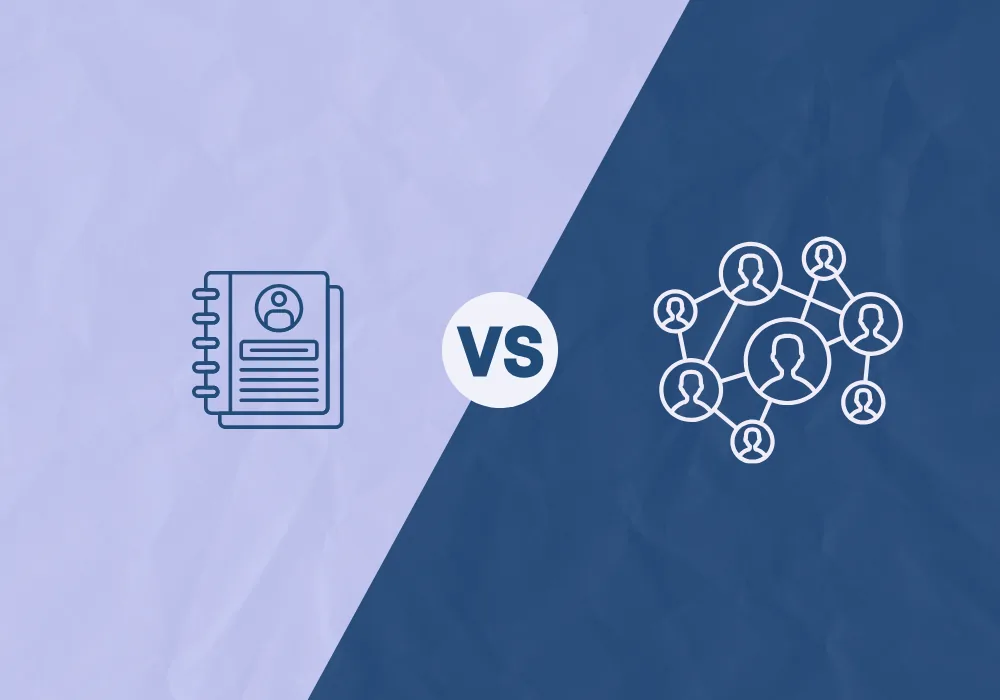
Most professionals have hundreds of contacts and almost no one to genuinely call when something matters. Here's the difference between a contact list and a community network — and why it changes everything.
Most professionals have a version of this experience.
You have hundreds of connections. People you met at conferences, classmates from university, former colleagues, contacts accumulated over years of working in your field. The list is long. And yet, when something genuinely matters — when you need the right person for a sensitive project, an honest opinion before a major decision, or an introduction that will actually land — you hesitate.
Not because the people aren't there. But because you're not sure the relationship is strong enough to ask.
That hesitation is the gap between a contact list and a community network. And understanding that gap is one of the most valuable things a professional can do.
When we talk about community networks — alumni networks, professional associations, faith communities, diaspora networks — we mean something specific: a group of people with shared history, shared values, and the kind of trust that makes real exchange possible. That is categorically different from a collection of accumulated contacts. This article is about what separates the two, and why it matters.
Competence Is Everywhere. Trust Is Not.
Platforms like Upwork, Fiverr, and 99designs have done something genuinely remarkable. They made the world's professional talent accessible overnight. Need a brand identity? A developer to build a feature? A copywriter for a launch? You can have proposals in your inbox within hours, from skilled professionals around the world, at competitive prices.
That is real, and millions of people rely on it every day for good reason.
But there is something those platforms cannot give you, and it's worth being precise about what it is.
When you hire through a talent marketplace, you are purchasing competence. The designer who delivers your logo may be genuinely talented. But she doesn't know your organization's history. She doesn't understand the internal politics of your board. She has no context for why your last three rebrands failed, and she won't push back when you're about to make the same mistake again. The transaction is complete when the file is delivered. The relationship ends there — because it was never meant to go further.
This is not a criticism of those platforms. It is simply a description of what they are designed to do. They are marketplaces for capability. What they are not — and what no marketplace can be — is a community.
In a community network built on trust, you're not reaching out to a stranger with an impressive portfolio. You're reaching out to someone who already understands your context. Someone who has stakes in your success because your reputation and theirs are woven together. Someone who will tell you the truth because the relationship matters more than the transaction.
That combination — competence plus relationship — is the most valuable professional resource in existence. And unlike talent, you cannot buy it. You can only build it.
What Trust Actually Makes Possible
It's worth being specific about the professional value that trust enables, because it's easy to treat it as a soft concept when its effects are concrete.
Referrals that genuinely open doors. When someone you trust recommends you, it carries a different weight than an endorsement from a stranger. The person receiving the referral knows something real is being staked on it. Doors that stay closed to cold introductions open for a trusted referral — because the recommender has already done the qualifying that a decision-maker would otherwise need to do themselves.
Honest advice that accounts for your actual situation. The feedback you get from someone who knows you is categorically different from the feedback you get from someone who doesn't. A consultant who doesn't know you will give you their best professional judgment. A trusted colleague will give you that, plus the parts they know you don't want to hear, plus the context they've watched you navigate for years. That second kind of advice is worth far more.
Collaboration without a contract for every exchange. In a trusted community network, favors happen. Not as exploitation — as the natural expression of a relationship that has value on both sides. You share an opportunity because you want the other person to succeed. You make an introduction because connecting two people you trust feels good. You offer your expertise because you know it will be reciprocated in kind when the time comes. That kind of fluid exchange doesn't happen between strangers, and it doesn't happen among contacts where the relationships are too thin to support it.
Access to what people know but don't publish. The most useful professional knowledge is often informal: which firm is actually worth working with, which opportunity has been oversold, which decision-maker responds to which approach. This knowledge circulates in trusted communities. It rarely makes it onto a public platform.
How Trust Erodes Without Maintenance
Here is the uncomfortable truth about professional relationships: most of the valuable ones you've built are quietly expiring right now.
Not because anything went wrong. Not because the trust was ever broken. Simply because distance and silence erode connection. The former classmate who became a partner-level attorney. The colleague who now leads a division at a company you'd love to work with. The mentor who moved to another city five years ago. These relationships didn't end — they just stopped being maintained. And without maintenance, even strong relationships thin out until they become, functionally, just another name in a contact list.
The reason this happens at scale isn't personal. It's structural. Most contact lists have no infrastructure for staying connected between the moments when connection becomes urgent. There's no system keeping you visible to the people who know you. There's no directory showing them where you are and what you're doing now. There's no regular touchpoint that keeps the relationship warm without requiring a specific reason to reach out.
So the relationship that was genuinely strong five years ago is now a cold contact — and reaching out feels awkward, because too much time has passed to ask for something without it seeming transactional.
This is a solvable problem. But it requires infrastructure, not just goodwill.
The Difference Between a Contact and a Community Member
A contact is someone you know exists. A community member is someone who knows where to find you, what you're doing, and that you're open to certain kinds of engagement.
The gap between those two things is information — and information requires a system to capture and maintain.
A searchable directory where professionals declare their expertise, their current focus, and what they're open to — mentorship, referrals, collaborations, advisory conversations — is not an administrative exercise. It is the infrastructure that turns latent trust into live opportunity.
Without it, a community network of a hundred professionals might as well be a hundred professionals who happen to share a mailing list. The potential is real. The activation never happens.
With it, the engineer who just moved to your city knows to reach out to the three people in the network who work in her sector. The entrepreneur looking for a co-founder can search by values, not just by skill set. The young professional navigating a difficult career decision can find the three people who have been exactly where she is now.
The relationships that make those connections possible were built over years of shared experience. The directory is just the mechanism that lets them do what they were always capable of.
Three Things a Real Community Network Does That a Contact List Cannot
It surfaces the right person at the right moment. In a contact list without a directory, connection depends on memory — yours and everyone else's. You find the person you remember, or the person who happens to post at the right time. In a live community network with current profiles, you find the person with the right expertise, in the right location, who has indicated they're open to the right kind of engagement. Memory is unreliable. A system is not.
It makes asking easy. One of the invisible costs of a thin contact list is the friction around reaching out. When you don't know someone well enough to be sure the request is welcome, you hesitate. You qualify extensively. You apologize for asking. In a trusted community, the shared context gives you permission. Everyone is there because they want to be useful to each other. The ask is expected, not presumptuous.
It compounds over time. Every referral strengthens both reputations. Every collaboration creates a track record. Every favor builds a reciprocal relationship that becomes the texture of a functional community. A contact list doesn't compound — it stays flat, occasionally useful, never transformative. A community network gets more valuable the longer it functions.
The Right Environment for This Kind of Community
There's a reason the most valuable exchanges in professional life happen in private: the visibility required for honest communication is incompatible with public performance.
When your professional conversations happen on platforms built for reach — platforms where your boss, your clients, your competitors, and people you've never met are all present — you adjust what you say accordingly. You become careful. You optimize for perception. That is the right behavior for those platforms. It is the wrong environment for the vulnerability that trust requires.
Saying 'I'm struggling with this and would value perspective from someone who has been here' is only possible when the audience is people who already know you and are invested in your success. That conversation cannot happen in front of an audience of thousands. It happens in a community network — one that is private enough to be honest and structured enough to be useful.
Building It Intentionally
The community network that delivers real professional value doesn't happen by accident. It requires decisions.
Build the directory before you need it. The worst time to try to compile where your network is and what they do is when you already have a specific need. Start now. Give people a simple way to update their profile — what they're working on, what they're open to, what they can offer. The directory that exists when you need it is the one that was built when you didn't.
Create structured reasons to exchange. The communities where relationships stay warm have regular, low-pressure mechanisms for interaction: peer learning sessions, mentorship pairings, introductions made with context rather than just connecting two people and stepping back. Structure reduces the friction of showing up. People who show up regularly build relationships. People who only show up when they need something don't.
Treat it as infrastructure, not an event. The annual gathering, the conference, the reunion — these things matter. But the value of a community network lives between them, not at them. The infrastructure that keeps people connected and visible to each other year-round is what turns occasional gatherings into the punctuation marks of an ongoing relationship, rather than the only relationship.
The talent platforms of the world have given us something extraordinary: the ability to find competent professionals for almost anything, almost instantly. That access is genuinely valuable, and there is no reason not to use it.
But it has also made something clearer by contrast: what a marketplace cannot give you is the professional who already understands you, who will tell you the hard truth, who has a stake in your outcome beyond the invoice. That kind of professional relationship is built over time, inside a community network where trust is the foundation.
You have contacts. Most of them could help you, and you could help most of them.
What turns that potential into something real is not more connections. It's a community worth belonging to.